ZizzleUp Editorial Team • April 14, 2026
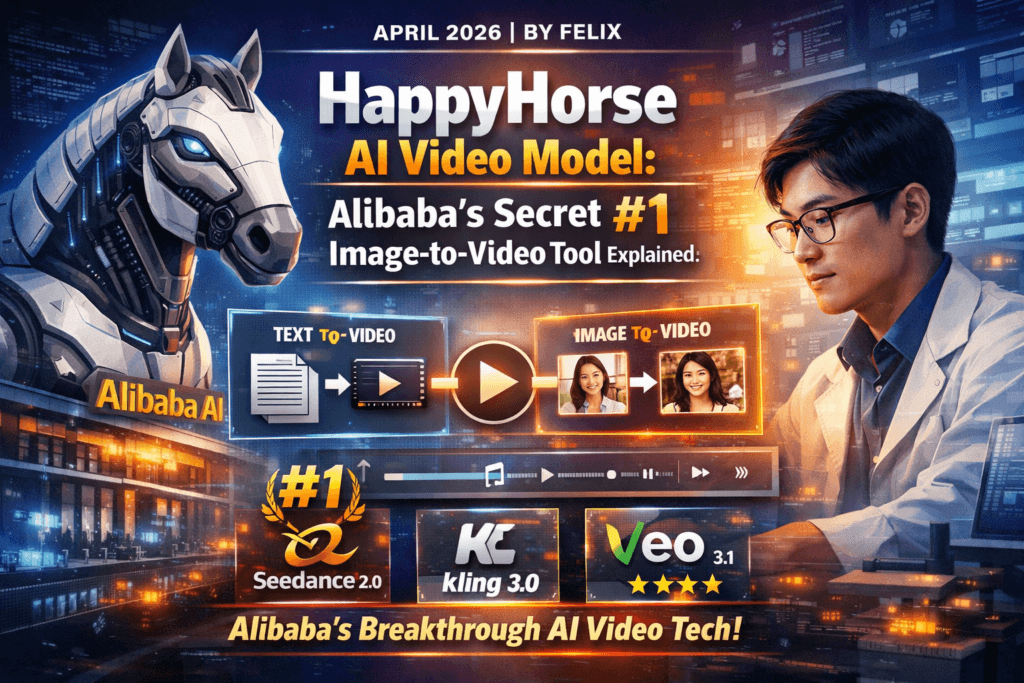
The HappyHorse AI video model is the most talked-about story in AI media this week — and for good reason. On April 7, 2026, an anonymous model called “HappyHorse-1.0” appeared on the Artificial Analysis Video Arena benchmark leaderboard. Within hours, it had climbed to the #1 position in both text-to-video and image-to-video generation, beating established giants like ByteDance’s Seedance 2.0 and Kuaishou’s Kling 3.0. Three days later, on April 10, Alibaba confirmed it was the creator — revealing one of the most dramatic stealth launches in AI history.
What Is the HappyHorse AI Video Model?
HappyHorse-1.0 is a multimodal AI video generation model developed by the Future Life Lab of Alibaba’s Taotian Group (operating under the newly formed Alibaba Token Hub, or ATH). The team is led by Zhang Di, a former Vice President of Technology at Kuaishou — the same company behind Kling AI, currently one of the leading AI video generators in the world.
The HappyHorse AI video model supports all four major generation modes in a single unified pipeline: text-to-video without audio, text-to-video with native audio, image-to-video without audio, and image-to-video with synchronized audio. Critically, it generates video and audio simultaneously in one inference pass — rather than using two separate models for the two outputs — which is a significant architectural advantage for quality and consistency.
According to Alibaba, the model is currently in closed beta testing. An API rollout is planned for April 30, 2026, and the team has confirmed HappyHorse will eventually be fully open-sourced with public GitHub weights.
How the HappyHorse AI Video Model Topped the Global Leaderboard
The story of HappyHorse’s rise is as dramatic as the model itself. Around April 7–8, 2026, an anonymous entry named “HappyHorse-1.0” quietly appeared on the Artificial Analysis Video Arena — a third-party benchmarking platform that uses blind Elo scoring. Users compare video outputs from two models side-by-side without knowing which model produced which clip, then vote for their preferred result.
The HappyHorse AI video model climbed immediately. Within hours of its debut, it ranked #1 in text-to-video without audio with an Elo score of 1,389 — leaving second-place Dreamina Seedance 2.0 at 1,273, a gap of 116 points. In image-to-video without audio, it scored an extraordinary 1,416 Elo, setting a new record on that leaderboard. In audio categories, it ranked #1 and #2, respectively — nearly matching ByteDance’s Seedance 2.0 in audio-synchronized output.
Speculation immediately erupted online. Was it Alibaba? ByteDance? A stealth lab? The model then briefly disappeared from the leaderboard, fueling more theories. On April 10, 2026, Alibaba officially confirmed its ownership via CNBC and Bloomberg, describing HappyHorse as a product of ATH’s AI Innovation Unit, still under beta development.
HappyHorse AI Video Model: Key Technical Features
While full technical documentation has not been publicly released, Alibaba and third-party researchers have confirmed several architectural details about the HappyHorse AI video model:
- Unified Transfusion architecture: HappyHorse uses a single-stream Transformer that jointly processes video and audio tokens in the same sequence. This is different from most competitors that handle video and audio in separate model passes.
- ~15 billion parameters: Claimed by the team, though not independently verified since public weights have not yet been released.
- Fast inference: Reportedly generates a 5-second clip at 256p in roughly 2 seconds, and a 1080p clip in approximately 38 seconds on a single NVIDIA H100 GPU.
- Native audio synthesis: Sound effects are generated by analyzing motion vectors in the video — if the model sees a foot hit gravel, it generates the specific crunch of that impact, rather than applying a generic audio track.
- Image-to-video support: Strong performance in animating still images, which directly benefits creators, e-commerce brands, and marketing teams who work with product photography.
These figures are self-reported by the Alibaba team and have not yet been independently confirmed by third parties. However, the Artificial Analysis Elo scores — which are based entirely on blind human preference votes, not self-reported metrics — are verified and highly credible.
HappyHorse AI Video Model vs. Seedance 2.0, Kling 3.0, and Veo 3.1
The HappyHorse AI video model enters a market already reshaped by OpenAI’s Sora shutdown on March 24, 2026. Here is how it stacks up against the current leaders based on available April 2026 data:
| Model | Creator | T2V Elo | I2V Elo | Native Audio | API Access |
|---|---|---|---|---|---|
| HappyHorse-1.0 | Alibaba (ATH) | 1,389 🥇 | 1,416 🥇 | ✅ Unified | ⏳ Apr 30 |
| Seedance 2.0 | ByteDance | 1,273 | 1,355 | ✅ Yes | ⚠️ Paused* |
| Kling 3.0 | Kuaishou | 1,243 | 1,243 | ⚠️ Limited | ✅ Live |
| Google Veo 3.1 | ~1,220 | ~1,210 | ✅ Yes | ✅ Live | |
| OpenAI Sora | OpenAI | — | — | ❌ | ⛔ Shutdown |
*ByteDance paused Seedance 2.0’s global rollout following copyright disputes with Hollywood studios. Elo scores from Artificial Analysis Video Arena, April 2026.
The gap between HappyHorse and the second-place Seedance 2.0 in text-to-video (116 Elo points) is, in statistical terms, large enough to be reliably distinguishable by users in blind testing. That is a meaningful quality signal, not noise.
Why Alibaba Matters in the HappyHorse AI Video Model Race
Alibaba’s entry into the top tier of AI video generation arrives at a strategically pivotal moment. OpenAI exited the market with Sora’s shutdown. ByteDance’s Seedance 2.0 — arguably the strongest prior contender — is temporarily sidelined by Hollywood copyright litigation. That leaves the HappyHorse AI video model, Google’s Veo 3.1, and Kuaishou’s Kling 3.0 as the realistic top-tier options for creators and developers right now.
Alibaba CEO Eddie Wu has declared AI development the overriding priority for the entire company, which spans e-commerce, chip design, cloud infrastructure, and entertainment. Alibaba has previously embedded its AI models directly into its e-commerce and advertising products. Analysts suggest HappyHorse could follow the same path — powering AI-generated product videos at scale across Alibaba’s vast merchant ecosystem, where high-volume visual content generation is a core business need.
Furthermore, the team behind HappyHorse was built by Zhang Di, who previously engineered Kling AI at Kuaishou. His defection to Alibaba in late 2025, and the rapid emergence of HappyHorse, signals that Alibaba has assembled world-class AI video talent capable of genuine frontier-level work.
Can You Use the HappyHorse AI Video Model Right Now?
As of April 14, 2026, the HappyHorse AI video model is not yet publicly accessible for general use. Here is the current access situation:
- Artificial Analysis Arena: You can test HappyHorse in blind head-to-head comparisons at the Artificial Analysis Video Arena. No account is required to participate in voting.
- Closed beta: Alibaba is running an invite-only closed beta. Creators can register interest at happyhorsesai.com for early access when the tool opens.
- Public API: Planned for April 30, 2026, according to the official HappyHorse team. Pricing has not been confirmed.
- Open-source weights: The team confirmed open-sourcing is planned, with GitHub and Hugging Face links listed as “coming soon” as of early April 2026.
In the meantime, the most practically accessible AI image-to-video tools with live public APIs are Kling 3.0 (from $6.99/month), Google Veo 3.1 (from $7.99/month), and Runway Gen-4.5 (from $12/month).
Preparing Your Images for the HappyHorse AI Video Model (and Any I2V Tool)
The HappyHorse AI video model‘s image-to-video capability — its strongest benchmark category — depends heavily on the quality of the source image you provide. Well-prepared images produce more coherent motion, better physics simulation, and cleaner audio-video synchronization.
Before uploading to any AI image-to-video platform, consider these steps:
- Use JPEG or PNG: These remain the most universally accepted input formats across all major AI video tools. Convert HEIC, WebP, or RAW files to JPG or PNG before uploading.
- Target 1080p or higher resolution: Higher resolution source images give the AI more detail to animate, resulting in sharper video output.
- Keep file size under 10 MB: Most platforms cap single-image uploads between 10–20 MB. Compress large images to avoid upload failures or slow processing.
- Ensure clean, even lighting: Consistent lighting in the source image reduces flickering artifacts in the generated video. Avoid mixed color temperatures or harsh shadows.
- Crop to your subject: For character or product animation, crop tightly around the primary subject. This improves the model’s focus and reduces background noise in the motion generation.
For quick, free image format conversion — whether you’re converting HEIC to JPG, resizing a high-res photo, or compressing a PNG for upload — ZizzleUp’s free online image converter handles all of these tasks directly in your browser with no account or software required.
Conclusion
The HappyHorse AI video model is the most significant AI visual media story of April 2026. Alibaba’s team, built by a former Kling AI architect, has produced a model that topped global benchmarks anonymously — and then confirmed its identity with one of the most dramatic reveals the AI world has seen this year.
With a public API launching April 30 and open-source weights on the horizon, HappyHorse is poised to become a major force in the AI image-to-video space. The competitive landscape — already reshaped by Sora’s exit and Seedance’s copyright pause — now has a new frontrunner. Whether HappyHorse maintains its leaderboard position once more vote data accumulates remains to be seen, but the early signal is unambiguously strong.
Watch for the April 30 API launch carefully. If the pricing follows Chinese AI video market conventions (roughly $0.04 per second of generated video), HappyHorse could undercut Western alternatives by a wide margin — and rapidly become the go-to image-to-video foundation model for developers worldwide.
Sources
- 🔗 Alibaba Revealed as Creator of HappyHorse AI Video Model — CNBC (April 10, 2026)
- 🔗 Alibaba’s HappyHorse AI Video Model Tops Global Ranking on Debut — Bloomberg (April 10, 2026)
- 🔗 Alibaba’s HappyHorse AI Video Generator Just Topped the World — RoboRhythms (April 13, 2026)
- 🔗 HappyHorse 1.0 Review: The Anonymous #1 AI Video Model — SeaArt (April 2026)
- 🔗 What Is HappyHorse-1.0? — WaveSpeed AI Blog (April 2026)
- 🔗 HappyHorse Model Decryption: Full Analysis — Apiyi Blog (April 2026)
- 🔗 HappyHorse Official Site — happyhorsesai.com (April 2026)