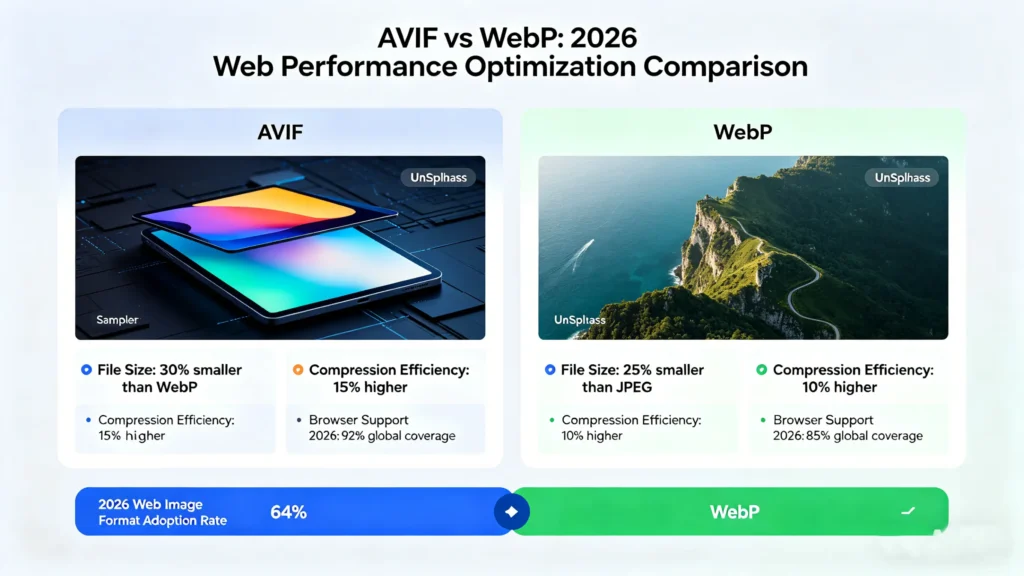
AVIF vs WebP image conversion is the biggest image optimization debate of 2026 — and the stakes have never been higher. Google’s Core Web Vitals now directly influence search rankings, and images remain the single largest drain on page load speed. Consequently, millions of developers, designers, and site owners are urgently asking the same question: should they convert their images to AVIF or WebP? This article breaks down every key difference so that you can make the right format choice for your website today.
Why Image Format Conversion Matters More Than Ever in 2026
Images typically account for 50–70% of a webpage’s total file size, making them the single most impactful target for performance optimization. Traditional formats like JPEG and PNG were designed decades ago — long before mobile-first browsing, 5G networks, and Google’s aggressive Core Web Vitals scoring.
Meanwhile, Google now uses Largest Contentful Paint (LCP) as a direct ranking signal. Furthermore, a 100ms improvement in page load has been linked to a measurable increase in conversions. As a result, developers who still serve unoptimized JPEGs in 2026 are actively hurting both their rankings and their revenue.
The two leading alternatives — AVIF and WebP — offer dramatically smaller file sizes without visible quality loss. Therefore, understanding how to choose between them is no longer optional for anyone who manages a website.
What Is AVIF? A Fast Breakdown
AVIF (AV1 Image File Format) is a next-generation image format developed by the Alliance for Open Media — a consortium that includes Google, Apple, Microsoft, Netflix, and Amazon. It uses the AV1 video codec to compress still images, achieving compression rates that far surpass older algorithms.
As of April 2026, AVIF has reached approximately 93–95% global browser support, including full support in Chrome, Firefox, Safari 16+, and Edge. Netflix’s internal benchmarks show that AVIF achieves roughly 50% better compression than JPEG on average — and around 20–30% better than WebP at the same visual quality.
Additionally, AVIF supports HDR, wide color gamut (10-bit and 12-bit depth), and alpha transparency. This makes it an ideal replacement for both JPEG and PNG in modern web workflows.
What Is WebP? Still a Strong Contender
WebP was developed by Google and released in 2010 with one clear goal: replace JPEG and PNG on the web. It has largely succeeded. WebP now enjoys approximately 97% global browser support — effectively universal coverage — and it supports both lossy and lossless compression, animation, and alpha transparency in a single format.
Moreover, WebP encodes dramatically faster than AVIF. While JPEG encodes in roughly 2ms and WebP in around 168ms, AVIF can take 1–2 seconds per image. Consequently, WebP remains the preferred choice for platforms that process large volumes of user-generated images in real time.
Facebook, for example, already delivers content in WebP format internally. Most CDNs — including Cloudflare, Cloudinary, and Imgix — also support WebP delivery automatically, making adoption straightforward for most teams.
AVIF vs WebP Image Conversion: Head-to-Head Comparison

| Factor | AVIF | WebP |
|---|---|---|
| Compression vs JPEG | ~50% smaller | ~30% smaller |
| Global Browser Support | ~94% | ~97% |
| Encoding Speed | Slow (1–2s/image) | Fast (~168ms) |
| HDR / Wide Color | ✅ Yes | ❌ No (8-bit only) |
| Alpha Transparency | ✅ Yes | ✅ Yes |
| Animation Support | Limited | ✅ Mature |
| Best For | Static site images, photography | UGC platforms, animations |
The data clearly shows that AVIF wins on compression and quality, while WebP wins on encoding speed and compatibility. Fortunately, you don’t have to pick just one.
How AVIF vs WebP Image Conversion Affects SEO and Core Web Vitals
Google officially recommends next-gen formats in PageSpeed Insights, and switching from JPEG to AVIF can directly improve your Largest Contentful Paint (LCP) score — one of the three Core Web Vitals metrics. Specifically, AVIF reduces image payload by 40–60% compared to JPEG, which means faster LCP times and stronger organic rankings.
For high-traffic websites serving 1,000+ images, the bandwidth savings compound significantly. Furthermore, faster pages reduce bounce rates, increase time-on-site, and ultimately improve AdSense RPM by boosting overall session quality.
The recommended implementation in 2026 is to use HTML <picture> tags to serve AVIF first, WebP as a fallback, and JPEG as a final safety net. This strategy covers nearly 100% of global users while maximizing performance for modern browsers.
<picture>
  <source srcset="image.avif" type="image/avif">
  <source srcset="image.webp" type="image/webp">
  <img src="image.jpg" alt="Your descriptive alt text" loading="lazy">
</picture>
How to Convert Images to AVIF or WebP in 2026
The good news is that AVIF vs WebP image conversion has become much easier in 2026. Multiple approaches exist depending on your workflow:
- Online converters: The fastest option for individual files. Tools like ZizzleUp let you convert JPG, PNG, and other formats to WebP or prepare files for AVIF conversion directly in your browser — no software installation required.
- CDN-based delivery: Cloudflare, Cloudinary, and Imgix serve AVIF or WebP automatically based on the browser’s
Acceptheader. This requires no manual conversion at all. - WordPress plugins: ShortPixel, Imagify, and WebP Express now support AVIF conversion natively. WordPress 6.x also includes built-in AVIF support in its core.
- Build pipelines: For static sites, tools like Next.js (via its
<Image>component) automatically serve AVIF to supported browsers since Next.js 13. - Command-line tools:
cwebpfor WebP andavifenc(via libaom) for AVIF are both free and available cross-platform.
For most bloggers and small business owners, an online converter is the simplest starting point. You can then move to a build pipeline or CDN approach as your image volume grows.
The 2026 Verdict: Which Format Should You Use?

Based on all available 2026 data, the recommended strategy is clear: serve AVIF as your primary format, use WebP as your fallback, and keep JPEG as a final safety net.
Specifically, use AVIF for: static site images, product photography, hero images, blog post visuals, and any content where you control the build pipeline. AVIF’s superior compression directly improves LCP and reduces CDN bandwidth costs.
Use WebP for: real-time image uploads, user-generated content platforms, animated images, and any environment where encoding speed is a constraint. WebP’s near-universal browser support and fast encoding make it the reliable, practical workhorse.
Either way, there is no good reason to keep serving unoptimized JPEG or PNG for web content in 2026. Even switching from JPEG to WebP alone delivers a significant improvement in page speed and Core Web Vitals. Making the switch is one of the highest-ROI technical SEO actions available to any website owner today.
“Start with WebP, introduce AVIF where it clearly helps, and your visitors — and your Core Web Vitals — will feel the difference.”
— Imagepulser, 2026
Sources
- DEV Community – AVIF in 2026: Why It’s the Best Format for Web Images
- Pixotter – WebP vs AVIF 2026: Benchmarks and Clear Winner
- WebGaro – WebP vs AVIF 2026: The Ultimate SEO Showdown
- Elementor – AVIF vs WebP: Which Image Format Reigns Supreme in 2026?
- Imagepulser – AVIF vs WebP: Which Wins in 2026?
- FreeImages Blog – WebP vs JPEG vs AVIF: Best Format for Web Photos in 2026
- Hashmeta – Image Optimization: WebP, AVIF, and Next-Gen Formats (March 2026)
- MergeImages.net – AVIF vs WebP vs JPEG: Best Image Format for 2026